
How Do Directors of Bank-Based Advisors Drive More Planning?
After years of their directors encouraging advisors in banks and credit unions to embrace financial planning, our most recent survey found that the typical bank-based advisor still initiated planning with only 14 new clients a year and counted only 7% of their book as active planning clients. Many advisors continue to tell their directors that planning is administratively challenging and takes too much time away from advising. In this series of Highlighters, we are reviewing the effectiveness of the approaches that directors are taking to address that issue. So far we have found that moving branch-based advisor off branch to a second story environment increases their financial planning engagement, but reducing the size of their book, or providing sales assistants do not.
As directors of bank-based advisors look for proven ways of boosting planning activity in their shops, they may have a growing lane already—the creation of advisor teams. Kehrer Group research has shown that organizing advisors in teams increases their production significantly above what would be expected from their tenure, AUM, and the composition of their business. Wouldn’t the team environment that is conducive to specialization of function and delegation of ministrative tasks also result in more financial planning?
For an answer, Kehrer Group once again turned to its proprietary database of 3,000 individual advisors from 175 banks and credit unions. Surprisingly, advisors working in teams actually do less planning than standalone advisors; they have 13% fewer active planning clients and initiate 17% fewer clients to planning during the year.
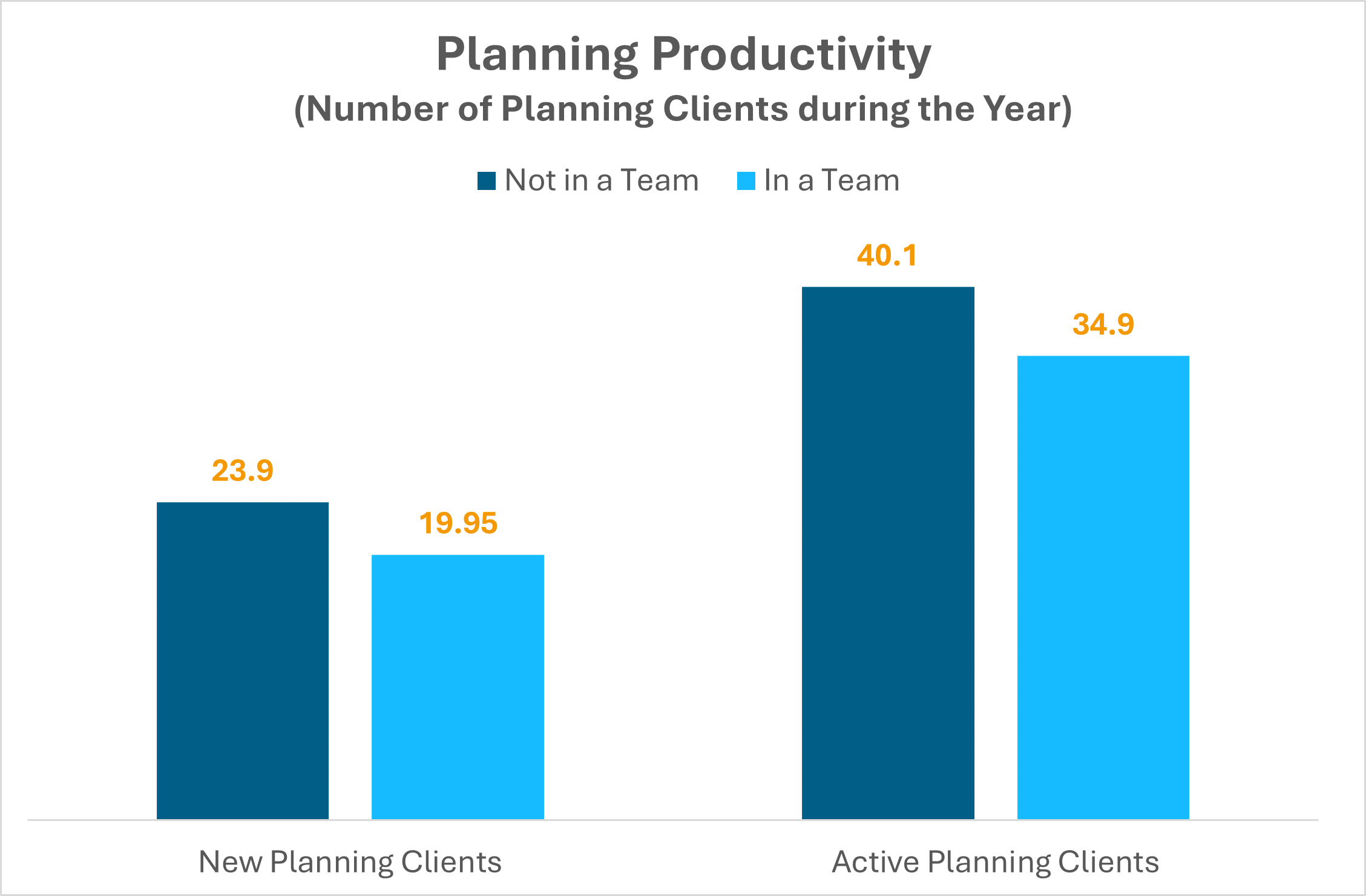
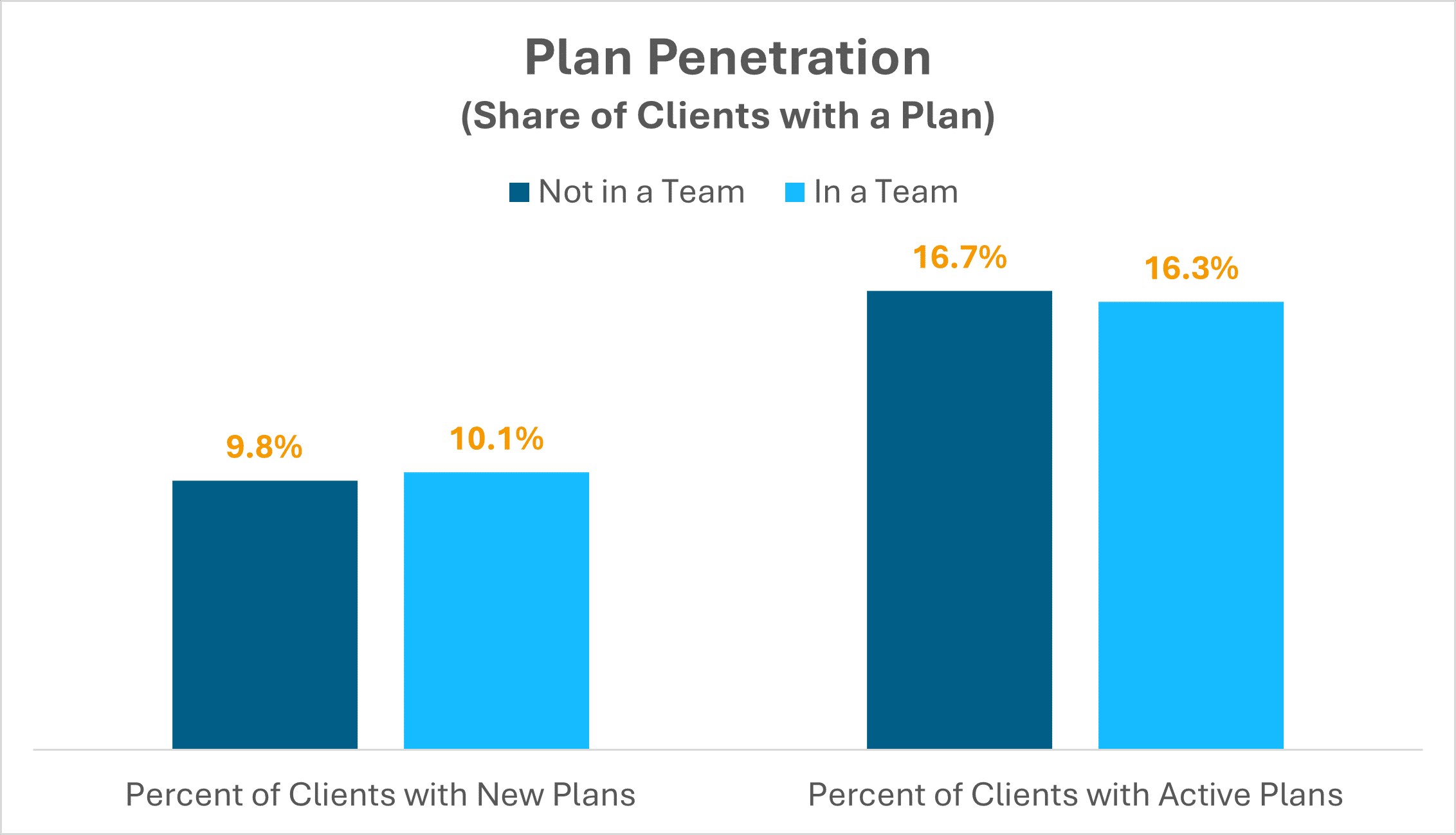
Similarly, advisors working in teams have slightly lower plan penetration of their client book, although they have a slight edge in the share of their clients newly engaged in the planning process during the year.
What’s going on here? Kehrer Group research on the structure and dynamics of advisor teams finds that the senior member(s) of the team often fail to delegate; instead of focusing on rainmaking and client relationships, they keep the details of developing the plan to themselves instead of taking advantage of less experienced team members to learn to be the team’s planning expert. This mirrors the experience that Kitces and Tharp found among independent financial planners. (The Kitces Report, Vol 1 2020.)
This analysis is part of a larger study by Kehrer Group sponsored by Raymond James Financial Institutions, “Win the Financial Planning Race: Best Practices in Driving Planning Engagement in Financial Institutions.” Future Highlighters will examine other levers in the Director’s toolkit, and their efficacy.
RAYMOND JAMES DEVELOPS INSTITUTIONAL INFRASTRUCTURE TO DRIVE ENGAGEMENT
Executing on financial planning requires more than advisor intent – it requires scalable infrastructure. Raymond James supports financial institutions with integrated capabilities designed to address the operational, capacity and expertise constraints identified in the research.
GOAL PLANNING & MONITORING
Scalable financial planning requires a consistent framework that advisors can apply across diverse client relationships. For banks and credit unions, Goal Planning & Monitoring provides a structured planning environment that can be scaled across an institution’s advisor force. This enables advisors to create, update and track client plans over time while reinforcing more consistent client engagement.
PARAPLANNING SERVICES
One of the most significant barriers to planning adoption is advisor capacity. Dedicated paraplanning support provides advisors assistance with administrative burdens, from data entry to plan development and analysis. Paraplanning services allow advisors to focus on client conversations while maintaining planning depth and quality.
FINANCIAL PLANNING CONSULTING
As clients’ needs become more complex, advisors require more specialized expertise. Financial planning consulting provides direct access to experienced planning professionals who can support advanced strategies. This model enables institutions to deliver sophisticated planning capabilities without requiring every advisor to develop deep technical specialization.
EXPERIENCED ADVISOR COACHING
Coaching is designed to support advisors in making financial planning a more central, repeatable part of their client relationships – without changing the institutional model. In environments with uneven financial planning adoption or specific branch demands, experienced advisor coaching helps institution-based advisors take steps to put financial planning into practice in their day-to-day work.
About Kehrer Group Highlighters
The Kehrer Group Highlighters package some of our most important findings, insights, and commentary into bite-size, digestible articles. We make the Highlighters available for free to the entire financial advice community—a small gesture of appreciation for a community that has done so much to support our work.

About Raymond James Financial Institutions
Advisors in the Raymond James Financial Institutions Division are generating, on average $890,000 in revenue, driven by the services that only a full-service broker-dealer can provide — including investment banking services, wealth and longevity planning, robust technology tools, curated advisor training, and a specialized financial institution support team — all of which help partners grow their investment programs, deepen relationships, integrate within the broader banking teams, and generate higher revenue per advisor.

About Kehrer Group
Kehrer Group is the bank and credit union financial advice community’s trusted partner for original thought leadership, insight based on data, and strategies that drive success. Kehrer Group’s legacy of research and analysis has advanced the delivery of investment services in banks and credit unions and shaped the industry into what it is today. Kehrer Group’s principals meld the wisdom gained from its long history in the industry with cutting-edge analytics, data that is robust and diverse, and a deep understanding of the key drivers of performance.
Learn more about what we do.