
Time to Evaluate Your Digital Capabilities
There are lots of estimates afoot about the size of the coming intergenerational wealth transfer—who owns it, and how it is currently invested. Financial advisors are more interested in who will inherit the assets, and what they will decide to do with them.
RFI Global looked to the best source of information available—the financial decisions and preferences of people who have recently received an inheritance, or believe they will receive one soon. According to RFI Global’s MacroMonitor, there are 5.14 million households in the US that have received an inheritance in the past 2 years, or expect to receive one in the next 12 months. The MacroMonitor provides details on the investment behavior of these “Inheritors” – where and why they invest where they do.
At the Kehrer study group on integrating the delivery of wealth management, Luke Allchin (RFI Global’s Director of Research) and James Langford (Commercial Vice President of the MacroMonitor) pointed out that 30% of the households that expect an inheritance in the coming year are actively looking to change primary financial advisors, frequently evaluate providers, or would think about switching. What is the key driver of the urge to change? Among the many reasons someone might change advisors, the lack of digital capabilities stands out.
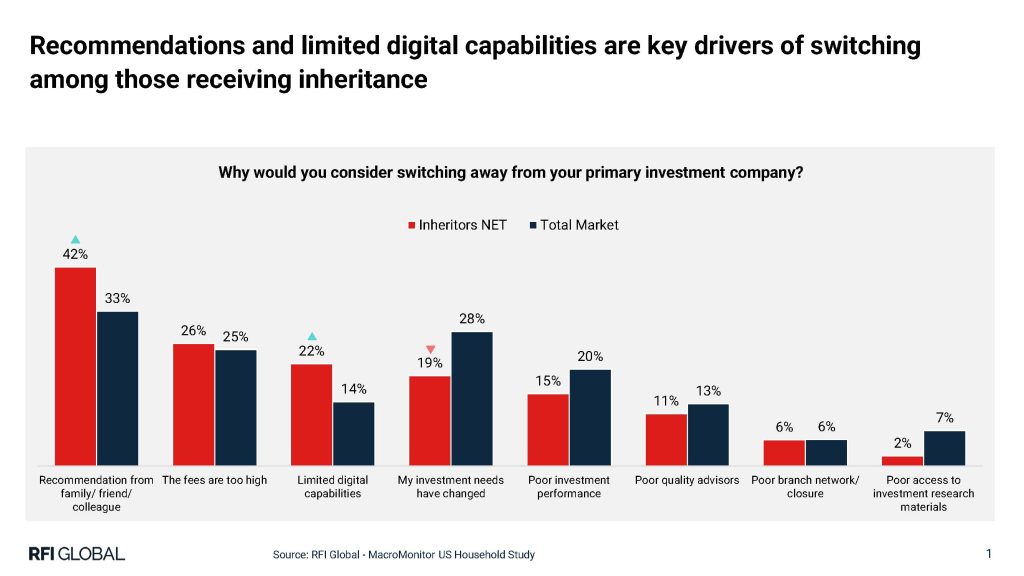
For investment firms looking to catch a slice of the wealth transfer wave, it may be time to reevaluate their self-directed and digital advisor capabilities to ensure they align with the preferences of those who stand to inherit the money.
The Kehrer Study Group on Integrating the Delivery of Wealth Management has been working on alternative paths to increasing the breadth and depth of wealth management penetration in financial institutions since 2011. This year’s meeting was held July 22-23 at the Carolina Inn on the campus of The University of North Carolina in Chapel Hill.
About MacroMonitor
RFI Global’s MacroMonitor offers the most extensive data set of US households. The study goes into field every 2 years and has been running since 1978.
The 2024/25 study is comprised of 5,000 household interviews, which were conducted online via desktop and mobile.
Respondents, all of whom are decision-making heads of households, are recruited via a probability-based sampling methodology.
Probability-based sampling, by design, mirrors the composition of US households. To enhance precision, the sample undergoes additional refinement through the derivation of the weight variable. This variable encompasses various demographic profiles including age, gender, race, and household characteristics such as family status, income, education level, and home ownership, as well as geographic attributes like region and area of residence.
In addition to the 4,000 interviews conducted as part of the core sample, a further 1000 interviews are conducted as oversamples. This includes Ultra-High Financial Assets, Young, Hispanic, Black, and Asian Households, all of which ensure robust samples of key household profiles and allow for greater granularity when segmenting the data.

About RFI Global
RFI Global is the only global data and insights company focusing exclusively on financial services. We empower financial service leaders with the market intelligence they need to drive innovation, enhance customer experience and accelerate growth. Partnering with the world’s top financial institutions, our expert team delivers tailored insights through a unique hybrid syndicated approach, drawing from over 200,000 consumer and 60,000 business interviews each year.
Find out more about RFI Global here: Data and Insights for Banking and Financial Services | RFI Global